From Lab Furnace to Production Line: A Scale-Up Approach for the 1400°C Silicon Carbide Rod Muffle Furnace
- By: Brother Furnace
- /
- Jun 25,2026
Materials R&D teams frequently run into the same bottleneck: a small laboratory muffle furnace with a chamber volume of just a few hundred milliliters produces excellent results—sintered density, phase structure, and mechanical properties all meet spec. But once the chamber volume is scaled up and batch size increases, product consistency starts to drift. Material at the edge of the load behaves differently from material at the center, the temperature profile no longer matches, and localized over-firing or under-firing can appear. This isn't a formulation problem—it's a sign that the thermal field design, loading configuration, and control logic haven't been scaled up alongside the chamber itself.
This article uses Brother Furnace's silicon carbide (SiC) rod box-type muffle furnace, rated up to 1400°C, as a working example to walk through what actually needs to change when moving from a lab-scale unit to a production-scale chamber furnace.
Why Lab Results Don't Simply "Scale Up"
A small lab-scale chamber furnace typically has a compact chamber and a light load, so heat travels a short distance from the heating elements to the sample. Temperature gradients across the chamber are easy to keep within a tight range. But once the chamber is scaled up and the load increases from a few tens of grams to tens of kilograms or more, several variables get amplified at the same time:
Greater thermal mass. A larger chamber and refractory lining store more heat, which changes the achievable heating and cooling rates. The ramp profile that worked in the lab may no longer reproduce the same core-to-edge temperature differential.
Higher loading density. More stacked layers of material complicate airflow and radiant heat transfer paths, often resulting in a chamber that reads "on temperature" while the core of the load is still lagging behind.
Tighter uniformity requirements. A ±10°C tolerance that was acceptable at lab scale can become the line between acceptable yield and scrap once production volume increases.
So the real challenge of scale-up isn't simply moving to a furnace with a bigger chamber—it's re-validating how thermal field design, loading configuration, and temperature control logic interact at the new scale.
The Role of the SiC Rod Muffle Furnace in Scale-Up
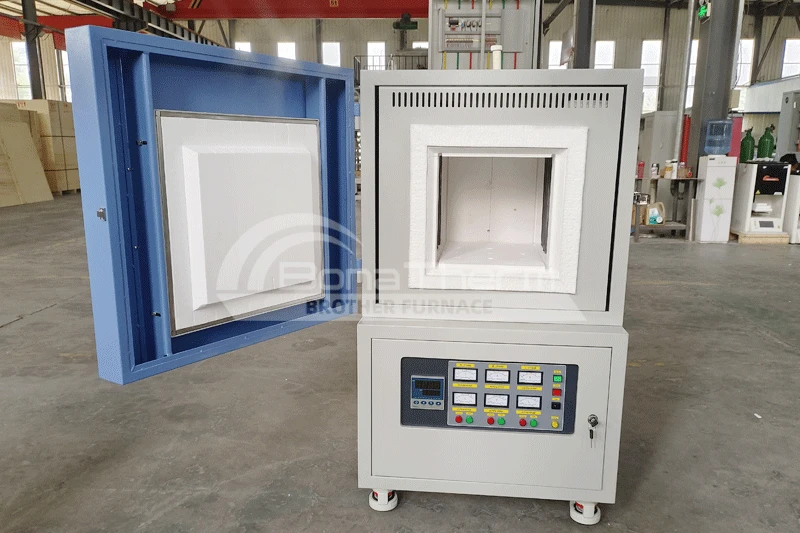
The Brother Furnace silicon carbide rod muffle furnace shown here illustrates several design features that are directly relevant to the scale-up stage:
1. Heating element layout — symmetrical SiC rods on both sides
Silicon carbide rods are arranged in rows along both sides of the chamber, heating the load by radiation. This layout provides good lateral temperature uniformity in a small lab unit, but at production scale, the number, spacing, and power density of the SiC rods need to be recalculated based on the actual chamber width. Otherwise, the center of a wider chamber can become a cold zone simply because it sits farther from the heat source.
2. Ceramic fiber insulation — a key factor in heating and cooling rates
The chamber lining uses ceramic fiber insulation, which has low thermal mass and good insulating performance, supporting faster heat-up and lower energy consumption. However, as chamber dimensions scale up, the total thermal mass of the insulation lining also increases. A heating rate calibrated in the lab (for example, 5–10°C/min) may not transfer directly to a larger box furnace—the core of a larger chamber may lag behind the programmed ramp, requiring re-tuning of the PID parameters.
3. Independent three-phase current/voltage monitoring — stability for continuous production
The control panel includes separate ammeters and voltmeters for phases A, B, and C. This is particularly important at production scale: when a furnace runs continuously over extended batch cycles, phase load balance directly affects heating element life and temperature stability. A single-phase setup is often sufficient for short lab-scale trials, but three-phase monitoring is standard practice on a production-scale chamber furnace, allowing early detection of load imbalance and advance warning of element degradation or localized faults.
4. Distributed ports for airflow and temperature sensing
Multiple pre-drilled ports are visible on the chamber floor, typically used for thermocouple placement or airflow distribution. A single thermocouple at the chamber center is generally adequate to represent the whole furnace at lab scale. At production scale, it's worth installing a grid of thermocouples across multiple positions (top/middle/bottom, front/middle/back) to measure the actual temperature field directly, rather than extrapolating the whole chamber's behavior from a single data point.
Practical Steps for Scaling Up the Process
Based on the hardware characteristics above, here's a recommended sequence for moving from a lab furnace to a production-scale box furnace or muffle furnace:
Step 1: Run a pilot-scale trial before jumping straight to the production unit
Insert an intermediate-volume pilot furnace between the lab unit and the final production equipment—for example, a chamber roughly 3–5 times the volume of the lab furnace. Use it to validate whether the heating ramp, soak time, and cooling rate need adjustment before finalizing parameters for the full production-scale equipment. This significantly reduces the risk of costly rework after committing to large-scale equipment.
Step 2: Re-map the thermal field rather than reusing the lab profile
Even with the same model and heating method, a scaled-up furnace will have a different actual thermal field. Map the heat-up curve and temperature uniformity under both empty and fully loaded conditions using multi-point thermocouples, and base your process parameters on this measured data—not on the parameter table carried over from the lab stage.
Step 3: Adjust loading configuration to match the thermal field characteristics
In a SiC rod-heated box furnace, heat is delivered radiantly from both sides toward the center. If parts are stacked too densely, they block the radiant path, causing the center of the load to lag noticeably in temperature. When scaling up batch size, redesign tray spacing and stacking height based on the measured thermal field, rather than simply scaling up the lab-scale tray arrangement proportionally.
Step 4: Establish batch sampling and traceability
During the early stages of scale-up, it's good practice to pull samples from multiple positions within the chamber for several consecutive batches (3–5 batches is a reasonable starting point) before increasing load size further. The data collected during this stage also becomes valuable input for later furnace refinements—such as adding circulation fans or adjusting zoned power distribution across the SiC rods.
Final Thoughts
A lab furnace answers the question of whether a process is feasible. A production line answers the question of whether that process is stable, repeatable, and scalable. There's no shortcut between the two—only rigorous thermal field validation and loading optimization can bridge the gap.
Brother Furnace has accumulated thermal field simulation data and field-measured results across a range of chamber sizes for its SiC rod muffle furnaces, box furnaces, and chamber furnaces, and can provide scale-up recommendations—from pilot trials through to full production—based on a customer's lab-stage process parameters. If your team is currently navigating the transition from lab to production, Brother Furnace's engineering team is available to help evaluate your thermal field design.